Monday, 26 January 2015

Evolve - Deconstruction

Evolve is an upcoming next-gen game that focuses primarily on a 4 vs 1 multiplayer system, with a team of Hunters fighting against one massive monster. I was planning on getting the game to use as part of my studies (as well as just because it looked fantastic), but after playing the beta that was released recently, I found the actual gameplay very lacking and unsatisfying. Due to this, I will not be purchasing the game when I can get what I require study-wise from videos and images. Regardless, I will continue to monitor the game for when they add new monsters to it so that I can study them as I will be doing so now with the current 4 monsters (1 of which hasn't been released yet, but there are images and data of it).

And so without further ado, I shall now go through each of the monsters in the order they were released and deconstruct them as best as I can.

Goliath


Goliath is the first monster; a mix of saurian and primate features lend to it's brutish muscular appearance. Upon first glance, it is clear that Goliath is a 'hands-on' sort of monster and prefers close combat as opposed to ranged. This is key in making it's design successful because it must be obvious to players what they are dealing with so they know what to expect. Saying that, however, Goliath does possess a somewhat secret ability in that it can breath fire. This idea of a hidden ability is great for putting players on their toes and allows the creature designers to add some really wild-card elements perhaps shown better in the other monsters, but still very relevant in Goliath's case. Here is one of the first trailers released for the game that shows of Goliath as the first monster (also I just absolutely love the trailer, the song and pacing is perfect):

https://www.youtube.com/watch?v=JsLR808dVAw

Each monster has 3 stages of evolution and can upgrade their unique abilities at every stage to both empower the monster and perhaps focus down a certain route, or go for a rounded offencive output. Here is an image of Goliath's 3 stages (strangely the only monster I can actually find images of the different stages):

Even in it's early stages, Goliath exemplifies an athletic brute creature.
So to the abilities, Goliath, as with all monsters, has 4 of them, represented here by this image:

3 out of 4 of Goliath's abilities focus on his brute strength: Leap Attack; Charge Attack; and Rock Throw. The 4th is of course the Flame Breath, that whilst not directly relating to the brute strength, does in fact compliment it's close-quarters battle stratagem due to it's shortish range. 

Design-wise, I would say that Goliath is indeed successful; it exemplifies everything it should and adds a bit of flavour through an extra ability without making it unbelievable because of it. Perhaps it could be perceived as the 'boring' or 'straight forward' class of monster because it's entire strategy revolves around charging in and hitting things, but in saying that, it fulfills the role and gives players the option if they want to take that up, as opposed to solely focusing on 'stealthy' or 'intelliget=nt' classes. 


Kraken


The second monster, Kraken, is a saurian and cephalopod hybrid, making for a rather disturbing appearance. Kraken's sinister visage makes it somewhat unclear to the initial viewer as to what such a monster is capable of; unlike Goliath, it is not necessarily apparent where it's skills lie. This monster actually plays the role of ranged combat, seeking to generally keep a distance from the hunters and strike them from afar with less fear of retaliation. Here is the trailer that announced Kraken's release:

As with Goliath, Kraken too has 4 abilities:

Lightning Strike: calls down a trio of lightning bolts that can converge to strike the hunters to deal massive damage.
Banshee Mine: homing orbs that explode on contact with hostile lifeforms and scream loudly in the process, best used as a distraction.
Aftershock: an area of effect attack that expels from the monster itself, damaging enemies that are too close.
Vortex: energy projectile that knocks back foes and damages them in the process.

For me, Kraken just has far too much going on in the way of abilities; it can use lightning as both projectiles and as a defencive manoeuvre, it can create homing mines and it can shoot a knock back projectile too. Oh, and did I mention it can glide/fly too? Yeah, it can do that as well. Where Goliath worked was that it had a theme (brute strength) and stuck to it, adding only one extra ability that worked in concert with the rest of it. Kraken on the other hand has the main theme of lightning based attacks, but then has 2 other attacks that don't seem to relate in any way. Flight works well to complement the lightning ranged attacks and fits with the theme, but the Vortex and Banshee Mine perform the same sort of ability as the Aftershock whilst seeming somewhat random in design: they keep the hunters at bay and allow the monster to escape. Perhaps this is due to the lightning theme being somewhat obscure in the first place, any extra ability could be deemed 'too much'. If the Banshee Mines were to be replaced by something else, probably lightning related, it would work better I think.

I think that aesthetically, the Kraken looks very creepy and cool, but doesn't necessarily relate particularly well with it's role as a ranged monster and even less so with it's abilities. It could be argued however that the otherworldly look helps marry the design and the variety of attacks. All in all, I would not say that Kraken was a successful design because of these factors.


Wraith


Wraith is the third monster to join the party and she (yes, they actually classified it as a she for whatever reason) is probably my favourite out of all the monsters. Her humanoid-esque body gives her a familiar look whilst the tentacled lower half and clawed limbs make her all the more sinister and otherworldly. For me, this just works so much better as a design than Kraken (poor Kraken); she looks fast, stealthy and deadly. A combat monster for sure, but one that performs hit and run style attacks over full on frontal assaults that would otherwise leave her in a sorry state. Wraith's physiology and abilities make it very difficult for the hunters to track, rendering the Trapper class somewhat useless against her; which is of course a shame for the player put in that position. Here is the trailer that unveiled the Wraith:


Wraith's 4 abilities all revolve around doing quick damage, isolating hunters and misdirection:

Abduction: the Wraith teleports to a hunter, grabs them and teleports back to her original position, thus isolating that hunter from the rest of their team.
Warp Blast: the Wraith teleports to a target position and creates a concussive blast that knocks back and damages enemies caught in it's radius.
Decoy: the Wraith creates a second version of herself that will last for a short period of time, whilst she herself turns invisible. The decoy will attack enemies nearby and thus can be used by Wraith to either deal extra damage by attacking alongside it or evade the hunters and slink off to heal or plan a new attack.
Supernova: the Wraith creates a smallish energy field in which hunters can be trapped. The field also empowers the Wraith with extra speed and damage output, meaning any hunters caught inside will be at the full mercy of her talons.

Wraith's abilities truly make it a terror creature, sowing fear and discord where and when she chooses. All her special attacks complement each other and this, combined with the fact that she plays like a glass-hammer (hits really hard but can't take hits in return), makes for a successful design. Aesthetically, she looks like her abilities; you can easily imagine those claws grasping a hunter into the darkness and the silent slithering of her tendrils as she stalks her prey only to attack them without warning.


Behemoth


I can't say a great deal about Behemoth as it has not officially been released yet, but I shall discuss what I know. The images I've used are concept art that shows the design near completion. Like Goliath, this monster appears to be another brute-type, favouring close range damage over long range. To contrast with Goliath, however, Behemoth is very slow, exemplifying a tank-class (high health and defence), opting to deal out significant damage whilst taking little in return.  Here is the teaser trailer for Behemoth, which is another fun way of showing off the monster to the audience:

https://www.youtube.com/watch?v=bduzyz9_fX8

Behemoth is probably my second favourite monster after Wraith, mainly due to it's interesting abilities that fit in with it's powerful-framed design. Covered in rocky armour, 3 out of 4 of Behemoth's abilities follow this earthy theme:

Lava Bomb: Like Goliath's Rock Throw, Behemoth can rip huge chunks of earth from the ground and throw it at the hunters. The difference is that the range of the Lava Bomb is exponentially further and as suggested by the name, the rocks thrown are molten and leave patches of burning lava on the ground that are dangerous to any enemies of the monster.
Rock Wall: Behemoth raises a massive semi-circular wall in front of itself, trapping hunters behind it or in front of it, allowing the monster to focus it's attacks on one isolated hunter, or take the time it has to escape.
Fissure: Behemoth smashes it's fists into the ground and creates a concussive shock wave that ripples out before it, damaging anything caught in it's way.
The fourth ability is Tongue Grab, which the Behemoth uses to impale hunters over a great distance and being them flying back into it's waiting arms.
So to conclude Behemoth, it really is a 'you see what you get' sort of monster. I would akin it mostly to Goliath in that it's attacks majoritaly revolve around one theme, but it has one special attack (it's Tongue Grab) with which it can surprise the hunters. From this conclusion, I can say that Behemoth is another successful design and I really wish the game-play wasn't so lacking, because I would love to play as this monster!

Taken from my most recent progress presentation, I have given each of the monsters a score rating based on how well I think they fulfill the criteria I believe they should be aiming to succeed in.


I have also created a decontructed image looking at the physical appearances of the 3 currently playable monsters, looking in particular for running themes and anatomical similarities that would better aid me in the practical response part of this research.


An update to the deconstruction!
I now own Evolve and have had a good chance to play it so i can get a better feel for how the monsters inhabit their environments. First off, however, it should be noted that it took a considerable amount of time to actually be allowed to play as all 3 currently available monsters. This is due to the player needing to upgrade each monsters' 4 abilities by causing damage with each of them to fill up a score bar that is tallied at the end of each match. This means to unlock Kraken, you need to first complete Goliath, and then Wraith is of course unlocked via Kraken. This wouldn't have been too bad, had all the moves been easy to upgrade, but certain ones (Kraken's Banshee Mines) were an absolute menace; yielding low damage output and being generally tricky to use.

After finally unlocking all 3 monsters however, I could properly test them out to see how they play, trying to ignore the rather poor framerate I was having to deal with. Interestingly, it turned out that my favourite monster to play as was my least favourite from the initial deconstruction stage, Kraken, whilst my least favourite monster to play as was my favourite from the initial deconstruction stage, Wraith. Goliath still sits happily in the middle. Reading back over my original musings, I feel that, on the whole, my decisions were fair, even if gameplay would dictate otherwise. One thing I would rectify is Kraken's score; I think I was a little harsh on it and gameplay has shown me that some of it's abilities do work well in unison. I would say though, that the Banshee Mines and Vortex abilities still stick out for me as not fitting quite as well as I would like to see. Even Kraken's visual design makes more sense when seen in motion though, as what could be seen as bony appendages as upper limbs are actually whip-like tendrils that arc lightning and are very pleasing aesthetically when they trail behind the monster as it flies through the air, silently gliding.

I am now going to use this practical research and create a response to it. I am going to design my own monster that will hopefully be fit for purpose and look the part alongside the existing monsters. The Shepherd cometh . . .

Sunday, 25 January 2015

Semester 2 - first supervisor meeting and project progress

Starting back in semester 2, the project is going rather slowly as the weight of it all is somewhat crushing, preventing productivity and hampering thoughts. So far, the research part of the project has really dampened it all for me; it feels like this massive separate entity that looms like an arrogant monster (rather apt) and only frustrates me that I don't know what to look at, where to go  and what to discuss.

However, my first supervisor meeting has helped with this problem greatly in the sense that all the research I have been trying to garner has been theoretical, and whilst this is of course important, it is not the be-all and end-all, instead I should of course be focusing on the practical research. By practical research, I mean things such as dissecting images and creating responses based on my findings. At any rate, the meeting majoritaly comprised of separating the practical and theoretical side of the project so as to show the contents required of each and then showing how they should be more interlinked and, in many cases, be one-in-the-same.

Something I had been thinking about was mythology and folklore, which interestingly was a topic at the very start of my project when I was considering doing graphic novels. Now however, I can look into the subject from the point of view of researching adaptation and interpretation. There is a rich visual history of creatures in mythology and folklore from many different parts of the world and the artistic media has taken great swathes of the knowledge and portrayed it in it's various forms. Many films and games indeed capitalise on the popularity of the subject and they adapt and interpret creatures to their own ends. Examples include: 'God of War', 'DreadOut', 'Beowulf', and 'Hercules' to name but a couple. I recently attained a book, 'Imaginary Animals - The Monstrous, the Wondrous and the Human' by Boria Sax, which looks into the history of a number of fantastical creatures throughout the years, so would be a good point of reference to gain an academic insight into the matter. I would like to perhaps write a case study on the subject, but will look to asking my supervisor at the next meeting as to what is involved in such a thing, as I have absolutely no idea where to even begin at the moment. Furthermore on the subject, for the practical side of it, I would be able to adapt and interpret mythological and folklore based creatures myself, creating particular tasks aiming to create a variety of designs that will hopefully focus on originality and iteration.

Another topic of discussion at the first meeting was that of creating a portfolio of creatures using the IP of the company Games Workshop. It would be my goal to one day send my work to them and provide art for their various books, as they are always looking for free-lance artists who they can rely on to create strong exciting pieces. Looking through a variety of the books, they contain a plethora of artworks from different artists, all with their own unique styles; the really good ones are those that you can instantly say, 'that's a . . . piece.' My personal favourite artist who does images for Games Workshop is Adrian Smith, here is a link to his website:
http://www.adriansmith.co.uk/
I believe that it is very important for me and would benefit me greatly to aim to develop my own personal style over this semester, refining it and making it unique so that, like Mr Smith's work (I love saying that), it can be instantly recognised and therefor hopefully be commended more. So, by interpreting the various creatures/creature-races of the Warhammer universe(s), whilst maintaining the Games Workshop designs, I will hopefully be able to put together a decent portfolio that will be two-fold in purpose, acting as both part of the practical research in my project, as well as giving me work that I can take to the company straight from finishing university.

Practical-wise, my project will be rather heavily traditional as i plan to use markers for most of my work, however by using digital techniques: scanning in sketches; printing them out; touching up final images in Photoshop etc. I can satisfy the need for the project to be computer related (what with it being the Computer Arts course and all). I have tried a few different makes of pens and find that the Copic Sketch markers, whilst expensive, are certainly my preferred choice. I guess it really is a case of you get what you pay for, but at the same time is also down to personal taste.

Research-wise, I have been watching videos and playing a couple of games related to this project, specifically 'Evolve' and 'Spore'. Now, I have 'Spore' to play any time I wish, which is great and fine, however 'Evolve' I recently played the beta and found the game-play itself to be somewhat lacking, so thus have come to the conclusion that any further research into the game will have to solely be conducted through images and videos as I don't want to commit to buying something that I don't feel will aid the project through personal game-play. The creature designs in 'Evolve' are indeed interesting however and I plan to do a break-down of each of them, looking at them in detail and giving my thoughts and opinions. To add to this, I will then create my own creature for the game, based on my research and again focus on originality and iteration as the main parts of the design process. 'Spore' on the other hand is incredibly interesting as the creature-creator part of the game allows you to create a wide variety of designs, all be-it that they are in the cartoony style of the game and are thus limited. This isn't necessarily a problem though, as it would be perfectly possible to take designs, aim to make them 'logical' and alter the style to suit whatever purpose they will be given. I will seek to take screen shots and even video if possible of the creature creator in action through my own hands. It is somewhat limited though in the sense that you need to go and collect extra parts throughout the level, meaning the best way to play it is by completing the stage and messing around in the editor at the end.

Finally, I shall just post up what practical work I have been doing, which majoritaly consists of drawing real-life creatures taken from images on Pinterest to create a back-log of sketches that I can return to for my own personal creature designs, perhaps expand on certain ones and of course to help show the incredible diversity in the animals, birds, insects etc. that live on our own planet.


I have also done a few tests based on the Warhammer race of Skaven (rat-men).

Profile tests based on various artist's styles.

Profile tests based on various artist's styles.

Skaven civil war battle sketch.

Skaven civil war battle refinement first pass WIP.

I will return with another blog post soon, most likely looking into and deconstructing the creatures from the game 'Evolve'.

Wednesday, 10 December 2014

Concept Development Document

One of my 3 hand-ins was that of the concept development document. Essentially what it entailed was to create a document that picked key examples of inspiration for our projects and discuss them in detail, explaining what they are and how they relate the the project. For me, I chose 5 key examples and wrote around 500 words for each, which I felt was enough to explain fully what I wanted to say without repeating myself. For each example I followed a 3 paragraph pattern: the first explained what the image(s) is/are and how it/they relate(s) to me; the second critiques the image(s), looking at both the positives and negatives; the third explains how the image(s) and its/their critique can inform my project.

And so, without further ado:

* NOTICE! The formatting is all messed up for some unknown reason and I have spent ages trying to fix it; it's not for happening, so I'm afraid it will just have to be read as is! *


Where It All Began


One of the first true inspirations for my work was the cover of ‘Harry Potter and the Goblet of Fire’, by illustrator Giles Greenfield. Already a fan of the series by that point, when the fourth book came out in the year 2000 with a large dragon splashed across the cover, I was hooked. I would always use this cover as a reference when I was younger and drawing dragons; it was just perfect to me and formed a deep nostalgia that I still hold to this day. The image itself depicts Harry competing in the Tri-Wizard Tournament, during the first task in which the champions must steal a special egg from a dragon’s nest; Harry’s dragon is a Hungarian Horntail.

Looking at the cover, I was always far more interested in the dragon than Harry and looking at it now from a critical point of view, it looks very much as if both the dragon and Harry are of equal value; sharing the same colour palette, level of detail and contrast. Continuing to look critically at the image, the dragon itself looks somewhat anthropomorphic, featuring almost human limbs, and especially the hands, having 5 long fingers, seem incredibly human also. From a technical point of view as a creature designer, it seems very out of place and doesn’t quite work. The horns atop its head too seem out of place; they are perhaps too small or should be located further down on either side of the
head. And yet, it works overall as a piece, making it particularly malevolent and creepy. It’s an exciting image with action and energy regardless of its technical issues, and for this reason it is successful.
As to how it relates to my work and project, it shows that adapting a creature from text does not necessarily mean sticking to the letter. It is far more important to have a degree of personal creativity and make something that looks how you want it to look, without compromising on what the client requires of course. It also shows that sometimes getting the feeling right is what’s important in an image; my earlier critical quibbles can easily be cast aside for the main point that anatomical accuracies can be sacrificed, to an extent, in order to get across the emotions you wish to portray to the viewer. Taking these concepts into my work will be crucial for me, as it should help working more loosely and not getting caught up in the ‘nitty-gritty’ until such details are needed, aiming instead for powerful pieces and designs that stand out.  


The Edge Chronicles

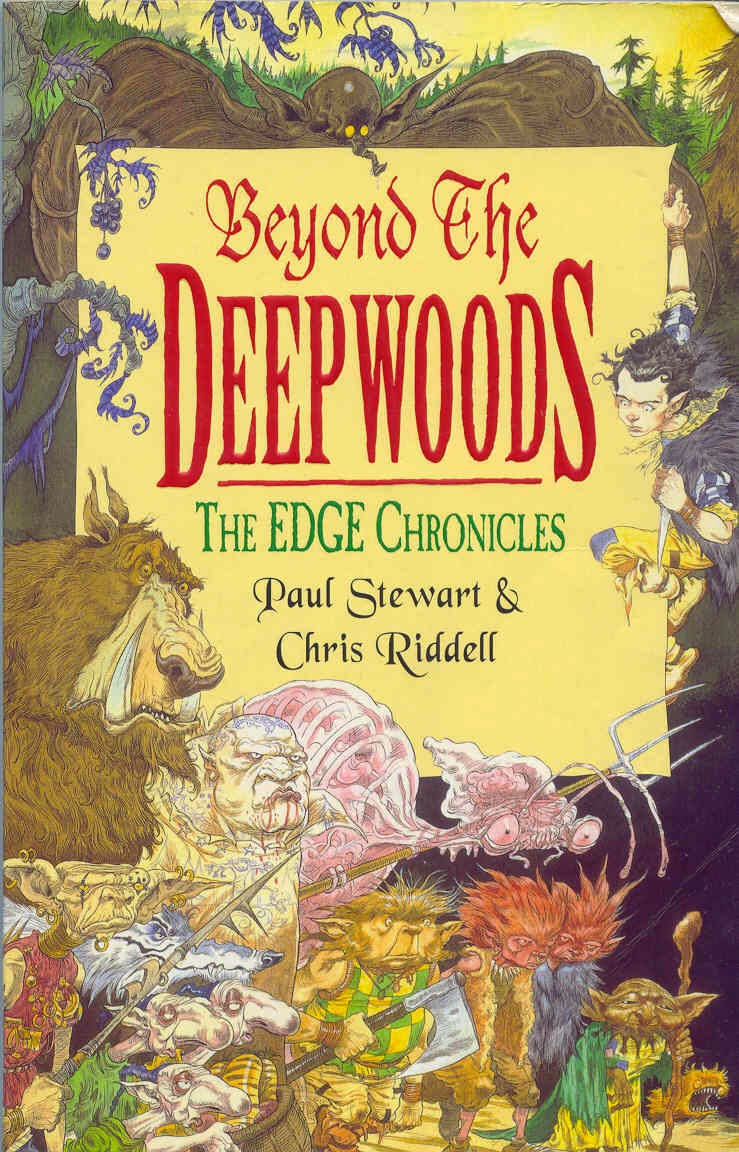
Again from a younger age, the art of Chris Riddell permeated much of my childhood as it featured in one of my favourite book series’, ‘The Edge Chronicles’. Looking here in particular at the first in the series,‘Beyond the Deepwoods’, the books have artwork throughout the pages, showing the characters, creatures, environments and situations as imagined by Chris Riddell and of course based upon the text written by Paul Stewart. The cover here shows the main character Twig (hanging down on the right side of the image), along with various other creatures and characters from within the story.

From a technical point of view, Riddell’s artwork is phenomenal; every one of his characters and creatures are full of life and personality. It helps of course that his style for this is somewhat cartoon-like, but even so, he uses realistic proportions and convincing designs that could easily be believed to be real. The sheer variety in his designs as well (helped by the extensive descriptions in the book) shows what a talented artist he is, breathing true life into each and every weird and wonderful creature and character. The style that he utilises is perfect for this type of book; that of a
children’s novel in which there are many threatening situations and brutal happenings, creating a fantasy adventure that shows what it would really be like to be cast into a terrifying world full of beasts and baddies.

What makes this so interesting to my project is mainly that it is oft left to the reader’s imagination as to how characters, creatures and environments are perceived, basing these imaginings on the text. The problem with this is of course that some writers don’t go into great depth with descriptions, leaving it very wide as to how something may look. This then leads onto the next problem, which is that everyone will have their own interpretation as to how something should look and of course, their image is right, to them at any rate. In turn, this leads to the project’s topic of adaptation. If all the imagery is left to the reader’s imagination, should a visualised piece be produced, such as a film or graphic novel, it will most likely be disappointing to them, from a visual stance at any rate. However, what makes ‘The Edge Chronicles’ series interesting is that as pointed out, there are illustrations throughout the book, showing each and every character and creature, so if it were to be adapted, readers would not be disappointed as long as it stuck to the original designs.

This idea helps from a theoretical point of view, but Riddell’s work also helps from a practical point of view as well. His art shows that I can maintain consistency with the realistic style I aim for, whilst still being able to add a lot of character to the creatures I am creating through slight exaggeration of features.      


Queen of Creatures


The art of American artist, Terryl Whitlatch, has only become truly apparent to me in the last couple of years. Yet I have unknowingly had one of her art books since I was quite young; ‘The Wildlife of Star Wars’. Since realising this, as well as finding my love for her work, she has been a great inspiration. I have always loved creatures and for me, her art exemplifies exactly what I seek to
emulate within my own drawings; a sense of realism.

Looking at Whitlatch’s work in a technical way reveals just how well-crafted and inspirational it truly is. Her grasp of animal anatomy is near flawless and her ability to create fictional creatures that still look as though they could actually exist is exceptional too. To find any flaws in her work for an
amateur like myself seems near impossible. The 2 examples given show this skill off just as well as any of her other pieces. If I could give one criticism, it would be that some of her designs look slightly like a cut and paste of different creatures put together. An example of this would be in the top image which looks like a dinosaur’s head on a lion’s body and with bird wings attached. At the same time, it is still an exceptional design and could be believed to exist or have existed.
Whitlatch’s work is the crux of my project from both a practical and theoretical point of view; her teachings and beliefs about the area of creature design that I aim to live out through my own work. The key things that I have taken from her to help with my own creature designs are to: be constantly studying existing creature anatomy; create creatures based on reality whilst allowing fantasy elements to influence but not overwhelm designs; use marker pens on scanned and printed designs to create natural tones and gradation without worrying about smudging pencil lines. Watching her Gnomon tutorial videos in particular have been incredibly useful for seeing her working process and has inspired me to start using markers on my work. Whereas before I was hesitant with colour and found it something of a trial, now with the markers I can add colour with relative ease and both quickly and effectively try out different colour schemes on creatures to see which looks best.

Attempting to maintain all these thoughts and ideas is of course important, but it should be recognised that my own creative style and stance, as well as other influences will permeate my work; Whitlatch’s teachings could be seen as a sort of grounding basis from which I can direct my own path.


Monster Menagerie


Monster Hunter is a game series that has enthralled me for years. It focuses primarily on the player as
a hunter who must go on quests to defeat increasingly difficult monsters. It is of course the monsters themselves that have me glued to the game, with well over 100 different monsters, not including all the sub-species and variant types. Shown here are just 3 such example of the extreme variety in the appearance and abilities of the monsters within the games. From the top: Zinogre; Kecha-Wacha sub-species; and Brachydios.
With a critical eye looking at the monster designs, it is clear that many of them follow the practice of
being based on real-life creatures and portray realistic anatomy. Many of the creatures however, push out the boat when it comes to how much fantasy element is put into them; to the benefit of most; but to the detriment of others. Those that it benefits become far more interesting in design and look impressively unique. Those where it is a detriment however, become almost unbelievable and somewhat jarring to the eye, in comparison to the other ones. Of course, this might not necessarily be a problem if the intention behind them was not to make them believable and just to focus on making them interesting to fight  and look at. It does, however, remove some of the immersion when a creature such as Brachydios (bottom image) is placed in a volcanic environment featuring predominantly reds and browns, when the creature itself uses a blue and green scheme.
What this brings to my project is more practical-based theories and concepts. It helps to show that the fantasy elements in a design can be pushed further, whilst still in keeping with the desire to create realistic creatures. It also shows that the environment in which a creature is placed is incredibly important for determining how it would fit in; if it looks out of place, either it’s a design flaw, or it was intended to be an alien to the environment and contrast with it to give it some context or back-story. This also makes for an interesting case that my project can benefit from; that the story of a creature, how it acts, lives, hunts etc. can be a solid grounding for how a creature should be designed and what main anatomical features it should be equipped with. Finally, the colouration of creatures is important and can be used as something to enhance the fantastical elements in a design; even garish colours can be used appropriately as exemplified by poison dart frogs in nature.


Gotta Design ‘Em All!


Pokemon was a massive part of my childhood; the cards, the games, the movies, the figures, I loved it. What’s more, all these years on and I still enjoy it as much as I ever did, if not more. A franchise based primarily on a wide variety of creatures, it seems clear then as to why it has struck a chord all this time and as to why it would be such a source of inspiration for my project. Of course, Pokemon is all in an anime/cartoon style, which doesn’t fit in with the way I like to work, but it is the ideas and concepts that are important. In steps one R.J. Palmer who has taken it upon himself to visualise these cartoony creatures into realistic beasts, based on animals that exist in our own world. Having released
a book titled ‘Realistic Pokemon’, I made sure to get a copy, as this is exactly the sort of thing I would like to produce as a final piece for my honours project.

Looking at the book itself and how the contents are arranged will help to give an idea as to how I might go about creating my own version with different creatures of course. Looking critically at it, I like the way in which the book includes sketches alongside the final pieces as shown in the second image, however, there is very little actual concept work; it mostly consists of what the final image will look like, pre-painted. Adding extra Pokemon to the images helps to add more interest to the

page and give an idea of scale. This is further enhanced by the Pokemon trainer scale figure Palmer has used alongside each of his images. The text that coincides with each image is something that bothers me with the book; Palmer’s language is very casual and he often complains about the original Pokemon designs of many that he is making realistic, for example: ‘Glaceon is dumb’. This, to me, is very unprofessional and could easily be put across in a more formal manner that explains why he dislikes them as opposed to just childish insults.

The designs of the Pokemon themselves are very interesting though and lend themselves to my aim of creating realistic creatures. A particularly good example of Palmer’s creativity is that of the Gengar evolutionary line (bottom picture). Gengar and its previous forms, Gastly and Haunter, are all ghosts with no true real-life basis for their designs. Palmer has been incredibly clever and made them into bat creatures; giving them a distinctive form and making them realistic in the process, whilst still maintaining a strong semblance of their original designs.

For my project, this brings a very plausible conclusion and outcome. Creating a book of creatures, in particular the various dragon species from the world of Harry Potter, would be a very professional thing to have if done in the right way. Taking what I have learned from this book, I would be sure to include as many concept sketches as possible to give readers an idea of the way in which the creatures evolved. I would also be sure to include other creatures to coincide with the main focus on each page to add character and perhaps hint at a sort of food-chain. Furthermore, a scale character would be incredibly useful to help relate the size of each creature to the viewer; numbers are on thing, but they don’t give a real idea of the exact size of something. Finally, text would be included to describe each creature, including ideas and opinions, but ensuring a level of quality in writing is maintained to come across as both academic and professional.

The designs of Palmer as well help to show me to think outside of the box with designs and the direct route might not always be the best one. This helps to coincide with the idea that iteration is incredibly important and the first idea will almost never be the best.